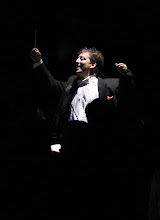
Leonard Bernstein and Alexander Frey, 1987
The 2008-2009 season finds celebrations all over the world commemorating the 90th birthday of Leonard Bernstein. It also marks the 65th anniversary when a young conductor stepped onto the podium in front of the venerable New York Philharmonic in a sold-out Carnegie Hall. It was 1943: the United States was at war, patriotism was high and the time was ripe for America to receive her first native musical hero with open arms. With millions of people across the country listening live on the radio, Leonard Bernstein gave the downbeat and blazed into that role. And the rest, as they say, is history.
During this anniversary year, a retrospective re-examination of Bernstein’s innumerable artistic accomplishments is inevitable. And certainly, one of the questions that will be asked is “What was his greatest accomplishment?” Was Bernstein’s highest achievement as composer, conductor or educator? Consider all those television lectures in which he taught music to a whole generation, or those revolutionary, sophisticated Broadway scores that set a high standard still unmet by a large percent of today’s musical theater composers. Think about all the hundreds of young musicians he helped and inspired or the many social causes to which he tirelessly devoted himself. What exactly was Leonard Bernstein’s greatest accomplishment?
I was one of those young musicians who Bernstein inspired. In March of 1985, I was in New York to perform at Alice Tully Hall. Lenny invited me over to his apartment in the Dakota for a drink afterwards. I walked into his studio, he poured us drinks, and the two of us sat talking into the wee hours of the morning about, well, everything.
Over a decade later, as I was preparing to record all of Bernstein's solo piano music for the KOCH International Classics label, I often thought of that beautiful studio in his apartment. It was the perfect setting for a well-known insomniac like Lenny to work long into the night: the rich deep colors of the dark brown carpet and red curtains framing the wooden shutters around the windows, those brass lamps illuminating floor-to-ceiling shelves of music, the magnificent fireplace by the door, that beautiful painting over the sofa and that big oak table which was his desk on which he studied his scores. The studio had a cozy feeling, although the space was quite large. At one point, while we were discussing composing and his own music, he pulled out a large hand-painted Japanese pot from under the piano that was full of pencil stubs. "I throw all my used pencils into this pot. Some of these pencils go all the way back to West Side Story and Kaddish", he told me. I could indeed imagine him composing some of the piano pieces on my CD in that very room.
I love listening to and performing Bernstein’s music. Yes, there is his sophisticated harmonic language, the “melodic concatenation”, the ingenious combining of tonal and atonal elements and the use of jazz. There is a total naturalness to his music, a sheer emotional quality that speaks to the heart; pieces of endearing lightness and mournful heaviness, joyful praise and lonely laments, moving tenderness and hard conflict, the brightest of sunrises and the darkest of nightmares. In short, the entire complicated and thorny range of human emotions. Bernstein traversed them all and took us with him on a most breathtaking kind of journey.
Bernstein’s desire to share every experience and feeling with others was an important aspect of his character that was encountered by anyone who came into contact with him or his music. This desire was also expressed in every note of music he composed. It was not unintentional that he wrote on the first page of his piano work, Touches: “Touches = gestures of love, especially between composer and performer, performer and listener…” For me, this was Lenny’s artistic creed.
I’ve always felt that a great accomplishment is something to which one commits his whole heart and soul for the betterment and benefit of others. Lenny committed his entire being to everything he did, whether conducting a Mahler symphony, teaching at Tanglewood or Schleswig-Holstein (and don’t forget his beloved Harvard), composing Jeremiah, Age of Anxiety, Kaddish, Mass or Candide, raising money for Amnesty International or giving quality time to inspire and talk to a young musician.
In this sense, all of Leonard Bernstein’s achievements were his greatest accomplishment.
© Alexander Frey, 2009
Links:
"Dream with Me" from Peter Pan: http://www.youtube.com/watch?v=TMeCa2d885U
"Touches", for solo piano: http://www.youtube.com/watch?v=EytXsPr1lww
www.amazon.com/Peter-Pan-2005-Studio-Cast/dp/B0009EZ0Q6
.