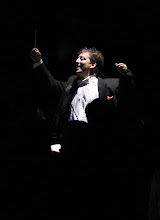
How to begin? What does it mean to be an artist, whether one is a musician, visual artist, dancer or any other kind of artist?
Any artist is a conduit of continuity. We are the keepers of the flame, the realization of a long chain of traditions passed on to us by our teachers, and their teachers, and their teachers. And the chain goes on. But each generation finds something new in the way they express themselves. Each new generation of artists is born into perhaps a different kind of world than their teachers. History changes, and the world they grow up in is transformed through the element that every artist races against and loathes: Time.
We live in a most highly technological age. But what does that mean for those of us in the arts? Technology is actually a response to the creative desire. Visual artists use computers to generate what they see in their minds. Composers use them to notate their music or generate sounds and patterns previously unheard. And technology brings all the arts together in what we know as multi-media. Technology put a man on the moon, an idea that was for generations considered a fantasy because there was no way to do it 100 years ago. But that fantasy was a very creative thought, and 100 years later it was the marriage between that creative thought and technology that made it possible for man to travel through outer space and actually walk on the moon.
We artists share what we do everyday. We bring beauty to our community, we challenge people to think in different ways and we improve the environment around us.
We sing our songs, tell our stories and paint in bold colors. We also record history. When the cavemen first started recording their lives and the world around them by drawing on cave walls, the traditions of story-telling and art began.
Anyone who solves a problem is an artist. In the business world, successful companies thrive because of creative thinking. And everyone in our world is actually an artist, but they don't know it.
When a person gets dressed in the morning, they choose a favorite tie that looks good with their suit, or a piece of jewelry that enhances their overall image, or a nice looking and comfortable pair of socks. This is creativity, artistic thinking. When we choose what we wear, we are expressing an image to convey during the day. Everyone is an artist, and it is a fundamental part of who we are.
We paint, we dance, we create. It's fundamental. And in that, we carry the history of humanity with us. The creative artist is the one who is involved with "big picture" thinking. We solve problems. But even at the highest levels, we don't arrive with everything done perfectly, but we strive in that never-ending quest for perfection, and that is part of our stimulus.
The most successful business people are creative thinkers. And the most successful artists are the ones who know how to sell their art.
But we fight everyday to be seen and heard. When schools cut budgets, the first thing to go is the arts. That's absolutely absurd, because it is the arts which challenges our thinking. And it is the artist who challenges our thinking because he or she is stimulated to look at the world in new and different ways.
© Alexander Frey, 2008
Saturday, April 19, 2008
Monday, July 9, 2007
Brunch with the German Romantics


Gothic monument by Karl Friedrich Schinkel. Viktoria Park, Kreuzberg, Berlin
 Caspar David Friedrich: The Cross on the Mountain

During Sunday brunch at Yorckschloesschen, Robert Morley walks by and joins me at my table. He also has his laptop, and goes to the online site of Bremer Sprachblog, which teaches German. Robert reads some highly complicated sentences aloud, commenting, "Listen to this. This is fabulous!"
Well, Robert, many people think the German language is ugly, guttural. That impression comes from all those World War II movies produced by Hollywood. But German is actually a beautiful language. I had the pleasure one evening of hearing the great German actress, Edith Clever, read portions of Goethe’s Die Leiden des jungen Werther (The Sorrows of Young Werther) in the original language. It was extremely expressive and emotional.
I think that lyric German poetry, particularly of the Romantic poets, was in many ways a verbal form of the chiaroscuro found in the influential paintings of Caspar David Friedrich. I saw the Friedrich collection at Schloss Charlottenburg here in Berlin and instantly remembered passages from Goslar, Faust and Der Erlkönig. Poets such as Goethe, Rilke, Schiller, Heine, Brentano, Arnim, Eichendorff and E.T.A. Hoffmann (who, by the way, is buried 4 blocks from my apartment) often echoed Friedrich’s penchant for symbolism and double meanings. Darkness and light, a sense of the Gothic, the depiction of dreams and German mythology permeate their poetry. To me, the sheer descriptiveness, the actual sound of the language, has an innate musicality and tactile feel. No wonder that these qualities inspired great Lieder. I cannot imagine the artistic void that would exist if these poets had never lived.
One of the first German poems I ever learned comes instantly to mind, Ich grolle nicht by Heinrich Heine which inspired Robert Schumann to compose the perfect song. I include it below with an English translation:
Ich grolle nicht, und wenn das Herz auch bricht,
Ewig verlornes Lieb! Ich grolle nicht.
Wie du auch strahlst in Diamantenpracht,
Es fällt kein Strahl in deines Herzens Nacht.
Das weiß ich längst. Ich sah dich ja im Traum, Und sah die Nacht in deines Herzens Raum, Und sah die Schlange, die dir am Herzen frisst, Ich sah, mein Lieb, wie sehr du elend bist.
I bear no grudge, even when my heart is breaking,
Love lost forever! I bear no grudge.
However you may shine in diamonds splendour,
no ray of light falls in the night of your heart.
I have long known this.
I saw you in my dream,
and saw the night in the space of your heart,
and saw the snake that eats at your heart,
I saw, my love, how very miserable you are.
So yes, Robert, it is a fabulous language.
© Alexander Frey, 2007
.


Tuesday, July 3, 2007
Messiaen and Die Berliner Luft

Gorgeous weather this morning, and after a brisk walk, I bury myself in my work.
The scores on the desk to study for next season: Bernstein's Peter Pan and West Side Story, Wildhorn's Jekyll and Hyde, Stravinsky's Rite of Spring (Le Sacre du printemps) and Firebird (L'Oiseau de feu), Mahler 5th symphony. The piano concertos to play-Gershwin Rhapsody in Blue, Grieg A minor, Mozart A major K. 488. And that's only part of the repertoire.
3 CDs to prepare for and record. And some solo recitals.
I look out of my studio windows just above the treetops. The sky has suddenly become dark as rainclouds summon up yet another storm. I do like summer storms. The rain purifies the air, releasing the fragrances of the earth.
Unknown to many, the city of Berlin actually sits on top of a massive water table. The air in this metropolis is unusually clean and fresh for a large city. That is because the earth is constantly being saturated with water from underneath. The air is always being cleansed and purified. That is why there is the old song, "Berliner Luft" (Berlin Air).
Das ist die Berliner Luft Luft Luft,
so mit ihrem holden Duft Duft Duft,
wo nur selten was verpufft pufft pufft......
so mit ihrem holden Duft Duft Duft,
wo nur selten was verpufft pufft pufft......
Whenever I arrive back in Berlin and step out of the airport terminal, I take a deep breath. The air is so different and fresh. Die Berliner Luft.
Craig Urquhart and I go to a concert last night of the Konzerthausorchester performed in Berlin's beautiful Schinkel-designed Konzerthaus, (see photo above). The orchestra is the reconstituted Berlin Symphony Orchestra (Berliner Sinfonie-Orchester). The program, of which some works are unfamiliar to me, was highly interesting. Stravinsky's Greeting Prelude, Berlioz Le Corsaire overture, Messiaen's Réveil des oiseaux, Bernd Alois Zimmermann's Musique pour les soupers du Roi Ubu. And those are just the works on the first half which was very long due to the moderator who gave long winded explanations between each piece of music.
I have loved Messiaen's music ever since I was a little boy entranced by the organ. But the Réveil des oiseaux, consisting mostly of the composer's transcriptions of birdsong, struck me the same way as his Canyons aux étoiles which I heard performed with orchestra featuring Messiaen's wife, the great pianist Yvonne Loriod, as soloist in Denver in 1998-superb music and ideas but way too repetitive and overly long. You are completely claimed by the opening 15 minutes only to be wandering for the next 30 or so through an endless chain of dominant seventh chords. Loriod's breathtaking performance and the Colorado Symphony Orchestra's ravishing playing were magnificent, but the sheer length and repetition of the work were tiresome. The piece does convey a great musical picture of the work's inspiration, Utah's Brice Canyon, but one can say the same thing in fewer paragraphs to greater effect.
And yet almost the rest of Messiaen's music leaves me completely transfixed. His sound world is a wonderful place to be where the colors and hues are infinite.
The Zimmermann work hits us similarly due its length. Though not as cerebral as the Messiaen, Zimmermann quotes entire portions of Wagner's Ride of the Valkyries and Berlioz' March to the Gallows from the Symphonie Fantastique whenever he can't seem to find a melody on his own. It cheapens what could have stood as a fine work.
We cut out to the new 5-star Hotel Roma for martinis before going down the street for a magnificent Italian dinner.
© Alexander Frey, 2007
.
Saturday, June 30, 2007
A Summer of Goodbyes
This has been a summer of goodbyes-to the Begleys as they move to China, to Brian and Leigh who've gone back to the United States-and each one tears my heart apart. For me, goodbye is the hardest word to say in my entire vocabulary. I can’t bear to say it to anyone I love-to my broken relationships, to friends who move away, and in the most painful moment of my life, to my father as he died in my arms.
But strangely enough, this has also been a summer of hellos-to some of the dear people who were in my life earlier and have now reappeared, to new friends who have just arrived in my circle and to little Nella, Marco and Andrea Permutti’s new baby daughter who will surely inherit and radiate the warmth, kindness and love that so much inhabit her parents’ personalities.
But today I am grieving over the goodbyes. This morning I couldn’t get those Cole Porter lyrics out of my head:
Every time we say goodbye I die a little
Every time we say goodbye I wonder why a little
Why the gods above me who must be in the know
Think so little of me
They allow you to go.
Well, every time I say goodbye, I cry a little and die a little. But in some cases, like this summer, I have cried and died a lot.
© Alexander Frey, 2007
Link:
http://www.youtube.com/watch?v=qSlzCDRywqc
.
But strangely enough, this has also been a summer of hellos-to some of the dear people who were in my life earlier and have now reappeared, to new friends who have just arrived in my circle and to little Nella, Marco and Andrea Permutti’s new baby daughter who will surely inherit and radiate the warmth, kindness and love that so much inhabit her parents’ personalities.
But today I am grieving over the goodbyes. This morning I couldn’t get those Cole Porter lyrics out of my head:
Every time we say goodbye I die a little
Every time we say goodbye I wonder why a little
Why the gods above me who must be in the know
Think so little of me
They allow you to go.
Well, every time I say goodbye, I cry a little and die a little. But in some cases, like this summer, I have cried and died a lot.
© Alexander Frey, 2007
Link:
http://www.youtube.com/watch?v=qSlzCDRywqc
.
Monday, June 25, 2007
Monday, June 25, 2007
Back in Prague. I close the season conducting a performance at the Karlin where I have been conducting for three seasons now. Prague is a special place in the summer.
Sandra calls and asks what I think about a roundtable discussion in front of the public at the Hollywood in Vienna Festival, and would I participate. The discussion will be on the first day of the festival after my opening concert. I tell her that I think it's a great idea and I'll be glad to be a member of the panel. The festival is turning out to be a very large production, all the better.
Have started relearning some of Korngold's early piano works for the Vienna Festival as well as learning some of Alexander Scriabin Etudes new to my repertoire.
Craig Urquhart gave me the scores to some of his new orchestral works. By the way, the word "score" in a musical context refers to the actual printed music, also known in German and some other languages as "Partitur."
Craig composes in the most personal of voices. Rather than compose sturm und drang to represent the conflicts in the world today, Craig's music represents the peaceful, calm oasis which we all seek and hunger for. His work is a balm for the ills on our planet.
We've known each other for 20 years. Craig the man, who is one of my dear friends, feels things very deeply, thinks in probing, thoughtful and philosophical detail about the world and the artist's mission and place in it, and pursues and realizes his own goals as as composer-pianist to touch and improve the human condition.
Normally residing in New York, Craig is spending a few months living in Berlin. It's nice having him as a neighbor.
S calls and to tell me she liked my blog essay on repentance and redemption (see one of my blog entries below). She asks whether the writing is mine or from another source.
All the blog essays here are completely my own original musings. They represent my thoughts on culture, events, reflections of my experiences and anything else that comes to mind that I may choose to include here. If I quote any material from other sources, those sources will be fully acknowleged and cited.
© Alexander Frey, 2007
Links:
http://www.craigurquhart.com/
http://www.franzwaxman.com/
http://www.bernardherrmann.org/
http://en.wikipedia.org/wiki/Alexander_Scriabin
Sandra calls and asks what I think about a roundtable discussion in front of the public at the Hollywood in Vienna Festival, and would I participate. The discussion will be on the first day of the festival after my opening concert. I tell her that I think it's a great idea and I'll be glad to be a member of the panel. The festival is turning out to be a very large production, all the better.
Have started relearning some of Korngold's early piano works for the Vienna Festival as well as learning some of Alexander Scriabin Etudes new to my repertoire.
Craig Urquhart gave me the scores to some of his new orchestral works. By the way, the word "score" in a musical context refers to the actual printed music, also known in German and some other languages as "Partitur."
Craig composes in the most personal of voices. Rather than compose sturm und drang to represent the conflicts in the world today, Craig's music represents the peaceful, calm oasis which we all seek and hunger for. His work is a balm for the ills on our planet.
We've known each other for 20 years. Craig the man, who is one of my dear friends, feels things very deeply, thinks in probing, thoughtful and philosophical detail about the world and the artist's mission and place in it, and pursues and realizes his own goals as as composer-pianist to touch and improve the human condition.
Normally residing in New York, Craig is spending a few months living in Berlin. It's nice having him as a neighbor.
S calls and to tell me she liked my blog essay on repentance and redemption (see one of my blog entries below). She asks whether the writing is mine or from another source.
All the blog essays here are completely my own original musings. They represent my thoughts on culture, events, reflections of my experiences and anything else that comes to mind that I may choose to include here. If I quote any material from other sources, those sources will be fully acknowleged and cited.
© Alexander Frey, 2007
Links:
http://www.craigurquhart.com/
http://www.franzwaxman.com/
http://www.bernardherrmann.org/
http://en.wikipedia.org/wiki/Alexander_Scriabin
Tuesday, June 19, 2007
Back in Berlin: late night musings.
First full day yesterday at home after arriving last night from flying half-way around the world. Although I was gone to Latin America to conduct for 8 days, I managed to stay on top of studying scores in my hotel room for current and upcoming performances, answering email on my laptop in the terracotta laced courtyard, while also catching up on my sleep after several other trips in the last few weeks to various countries.
Now back at home, I paid bills, practiced the piano. Dinner outdoors last night at some restaurant at Alexanderplatz where S and R and I dined on expensive salads, strangely over-priced for this part of the city. S asks me for advice about her boyfriend who seems to have a slight drinking problem. I say there is no such thing as a "slight" drinking problem.
I got home after dinner at around midnight. Jet lag rears its ugly head and I find myself still awake now at 3 in the morning. Before I write this blog sitting at my desk in my studio, I pull Ned Rorem's most recent diary, Lies, from the bookshelves. One of the notes I wrote in the margins tells me I read the book in April 2001. Several of the various pages of which I bent the corners over contain Rorem's views of the roles of composer and performer. I am also reminded of my feeling that this diary is the most humane of his to date.-touching, poignant, sad, as it deals with the illness and death of his long-time partner, organist-composer James Holmes. I've met Rorem several times and twice when he was with Holmes at national conventions of the American Guild of Organists. In 1996 at the AGO convention in New York City, the three of us had a long, friendly discussion about Rorem´s organ concerto as well as talking about Chicago and Hyde Park where both Rorem and I spent our respective childhoods. Jim, even though often overshadowed by Ned's celebrity, was clearly his equal intellectually and was as a performer and church musician what Ned is as a composer. The Muse works both ways. We had a enjoyable conversation. The two were very affable.
Such didn't seem to be the case when I saw them two years later at the AGO national convention in Denver. There they were standing near the exhibit hall of the convention hotel. I was glad to see them and walked over and said hello. They both seemed very remote, almost completely silent. I couldn't figure it out. I only found out three years later in April 2001 when I read Lies and discovered that Jim was dealing with symptoms and illness of cancer and advanced AIDS during that summer in Denver. He died 6 months later.
Ned lives in the same building as Mendy Wager. When I first started staying at Mendy's whenever I came to New York, he lived one floor above Ned. Mendy later sold his apartment and bought a new one on a lower floor. Now he lives below Ned. I actually found out about Jim's death from Mendy before I read Lies, though I didn't know the timing and therefore didn't connect the dots about Denver. I think I may have written Ned a note and slipped it in is mailbox while at Mendy's, though I am not 100% sure.
Speaking of which, Craig is living here in Berlin for a few months while handling all things Bernstein here in Europe. CuQu is one a composer who composes with the most personal of voices. We've been friends for 20 years. He wrote the booklet notes for my CD of the complete piano works of Leonard Bernstein and helped me a great deal during my research and preparation for my recording of Bernstein's Peter Pan. Craig has undertaken managing Ned in the past few years. Mendy Wager was one of Leonard and Felicia Bernstein's closest friends. Lenny died in Mendy's arms. I first met Lenny in 1985. I later became a protege and assistant conductor to John Mauceri starting in 1994. John was Bernstein's most important conducting protege. At that time, I was Music Director of the Berliner Ensemble. One of my predecessors in that position was Kurt Weill. In 2000-2001, I was John's assistant for performances of Weill's opera, The Eternal Road (Der Weg der Verheissung in German) which we toured in Germany, Israel and New York. Mendy's father, Meyer Weisgall, was the original producer of world premiere of The Eternal Road in 1936 in New York. I first met Mendy when he came to Germany to see our production. Mendy and John had been friends for almost 30 years. I could continue this line of thought, but I only want to show that this is but one of many interrelated circles of people and events that make up my life.
Helen Dewitt and I discussed her current book the theme of which is suicide. So far, none of the literary agents Helen has approached has shown interest in the idea. I say, "Helen, when I find a new fictional book to read, I like to be a good story. It can be about anything, something challenging. But I think the last subject that would peak my interest would be that of suicide." She responds by saying that maybe she should write a non-fiction book about the subject.
I mention to her my discussion with Lisa about the project, saying that her (Lisa's) well-thumbed extensive collection on the subject (Egad, what kind of friends do I have?) includes such books as William Styron's Darkness Visible, Kay Jamison's Night Falls Fast and Andrew Solomon's The Noonday Demon. Lisa also mentions her favorite German works on suicide ("my fave German works on the subject are..") Lang, as well as Bernhard's Correction, Peter Handke's A Sorrow Beyond Dreams.
I took Helen's book, The Last Samurai, with me on my trip. This amazing novel, which has been universally praised as masterpiece and path-breaking in it's style of story-telling and earned Helen the honor of being one of TIME magazine's 100 most influential people, claims me from page 1. "And you want to follow this with a book about suicide?", I ask.
Goodnight!
© Alexander Frey, 2007
.
Now back at home, I paid bills, practiced the piano. Dinner outdoors last night at some restaurant at Alexanderplatz where S and R and I dined on expensive salads, strangely over-priced for this part of the city. S asks me for advice about her boyfriend who seems to have a slight drinking problem. I say there is no such thing as a "slight" drinking problem.
I got home after dinner at around midnight. Jet lag rears its ugly head and I find myself still awake now at 3 in the morning. Before I write this blog sitting at my desk in my studio, I pull Ned Rorem's most recent diary, Lies, from the bookshelves. One of the notes I wrote in the margins tells me I read the book in April 2001. Several of the various pages of which I bent the corners over contain Rorem's views of the roles of composer and performer. I am also reminded of my feeling that this diary is the most humane of his to date.-touching, poignant, sad, as it deals with the illness and death of his long-time partner, organist-composer James Holmes. I've met Rorem several times and twice when he was with Holmes at national conventions of the American Guild of Organists. In 1996 at the AGO convention in New York City, the three of us had a long, friendly discussion about Rorem´s organ concerto as well as talking about Chicago and Hyde Park where both Rorem and I spent our respective childhoods. Jim, even though often overshadowed by Ned's celebrity, was clearly his equal intellectually and was as a performer and church musician what Ned is as a composer. The Muse works both ways. We had a enjoyable conversation. The two were very affable.
Such didn't seem to be the case when I saw them two years later at the AGO national convention in Denver. There they were standing near the exhibit hall of the convention hotel. I was glad to see them and walked over and said hello. They both seemed very remote, almost completely silent. I couldn't figure it out. I only found out three years later in April 2001 when I read Lies and discovered that Jim was dealing with symptoms and illness of cancer and advanced AIDS during that summer in Denver. He died 6 months later.
Ned lives in the same building as Mendy Wager. When I first started staying at Mendy's whenever I came to New York, he lived one floor above Ned. Mendy later sold his apartment and bought a new one on a lower floor. Now he lives below Ned. I actually found out about Jim's death from Mendy before I read Lies, though I didn't know the timing and therefore didn't connect the dots about Denver. I think I may have written Ned a note and slipped it in is mailbox while at Mendy's, though I am not 100% sure.
Speaking of which, Craig is living here in Berlin for a few months while handling all things Bernstein here in Europe. CuQu is one a composer who composes with the most personal of voices. We've been friends for 20 years. He wrote the booklet notes for my CD of the complete piano works of Leonard Bernstein and helped me a great deal during my research and preparation for my recording of Bernstein's Peter Pan. Craig has undertaken managing Ned in the past few years. Mendy Wager was one of Leonard and Felicia Bernstein's closest friends. Lenny died in Mendy's arms. I first met Lenny in 1985. I later became a protege and assistant conductor to John Mauceri starting in 1994. John was Bernstein's most important conducting protege. At that time, I was Music Director of the Berliner Ensemble. One of my predecessors in that position was Kurt Weill. In 2000-2001, I was John's assistant for performances of Weill's opera, The Eternal Road (Der Weg der Verheissung in German) which we toured in Germany, Israel and New York. Mendy's father, Meyer Weisgall, was the original producer of world premiere of The Eternal Road in 1936 in New York. I first met Mendy when he came to Germany to see our production. Mendy and John had been friends for almost 30 years. I could continue this line of thought, but I only want to show that this is but one of many interrelated circles of people and events that make up my life.
Helen Dewitt and I discussed her current book the theme of which is suicide. So far, none of the literary agents Helen has approached has shown interest in the idea. I say, "Helen, when I find a new fictional book to read, I like to be a good story. It can be about anything, something challenging. But I think the last subject that would peak my interest would be that of suicide." She responds by saying that maybe she should write a non-fiction book about the subject.
I mention to her my discussion with Lisa about the project, saying that her (Lisa's) well-thumbed extensive collection on the subject (Egad, what kind of friends do I have?) includes such books as William Styron's Darkness Visible, Kay Jamison's Night Falls Fast and Andrew Solomon's The Noonday Demon. Lisa also mentions her favorite German works on suicide ("my fave German works on the subject are..") Lang, as well as Bernhard's Correction, Peter Handke's A Sorrow Beyond Dreams.
I took Helen's book, The Last Samurai, with me on my trip. This amazing novel, which has been universally praised as masterpiece and path-breaking in it's style of story-telling and earned Helen the honor of being one of TIME magazine's 100 most influential people, claims me from page 1. "And you want to follow this with a book about suicide?", I ask.
Goodnight!
© Alexander Frey, 2007
.
Back home
Hello all,
I arrived last night from my trip to Latin America. I am still slightly agog about the long 10 1/2 hour flight during which the woman sitting next to me didn't get up to go to the bathroom at all during the whole time.
© Alexander Frey, 2007
.
I arrived last night from my trip to Latin America. I am still slightly agog about the long 10 1/2 hour flight during which the woman sitting next to me didn't get up to go to the bathroom at all during the whole time.
© Alexander Frey, 2007
.
Subscribe to:
Posts (Atom)